FRP Piping Assembly and Shop Prefabrication
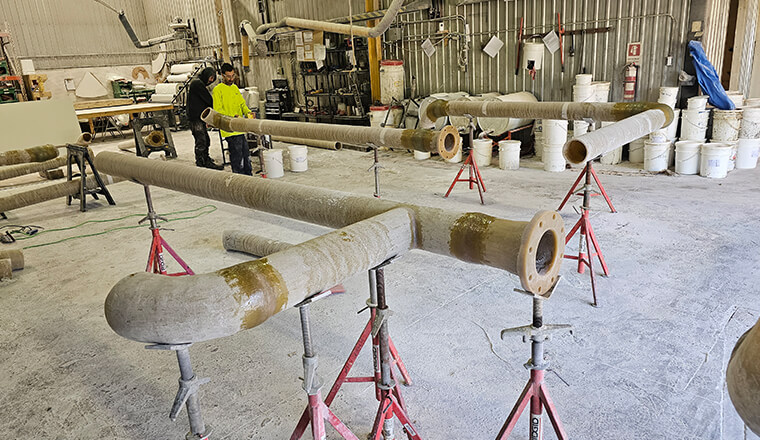
Troy Dualam Services provides shop fabrication and assembly of fiberglass-reinforced plastic (FRP) piping, fittings, spool assemblies, ducts, nozzles, flanges, manways and other custom industrial FRP components. Work is fabricated to approved project drawings, specifications and defined design and service conditions.
Dual-laminate work may be provided when the liner material, resin system, joining requirements and service conditions are defined in the project scope. FRP and dual-laminate systems can be selected for corrosive industrial service when the material system is suitable for the defined operating conditions.
What the Shop Scope Can Include
- FRP piping, fittings and spool assemblies made to approved drawings.
- Ducts, nozzles, flanges, manways and other non-standard FRP components defined by the project.
- Fit-up for connections to tanks, vessels and other process equipment.
- Repair, modification and restoration of existing FRP components when inspection confirms a suitable scope.
- Coordination with field installation and integration requirements.
Engineering, design and material selection are provided or coordinated only where included in the agreed project scope. TDS does not represent every piping assembly as a complete storage-tank design or manufacture scope.
Service Data Required Before Fabrication
FRP piping is selected and fabricated for a defined service—not from pipe diameter alone. The project information should identify:
- Fluid or mixture, concentration and contaminants.
- Operating and upset temperatures.
- Internal pressure, external pressure or vacuum.
- Solids, abrasion and expected cleaning methods.
- Pipe sizes, routing, supports, external loads and equipment interfaces.
- Joint design, installation method and field access.
- Applicable project standards, inspection, testing and documentation requirements.
Inspection and Testing Follow the Project Scope
Inspection and testing are project-specific. The required methods, extent and acceptance criteria are defined by the component, service conditions, project specifications and agreed scope. Dimensional checks, liner inspection, spark testing, pressure testing or other examinations are stated only when required by the approved project procedure. No single test applies to every assembly.
From Shop Assembly to Field Work
TDS supports industrial projects across Canada through a combined shop-and-field delivery model. Shop fabrication or preparation can be coordinated with on-site installation, joining and integration, subject to project location, scope and execution requirements. TDS provides field joining, installation and integration in accordance with the approved project scope, procedures and specifications.
Industrial Applications
These services support chemical processing, pulp and paper, food processing, petrochemical and other industrial operations, water and wastewater treatment, and industrial manufacturing.
Request an FRP Piping Assembly Quote
Send the available drawings or isometrics, service conditions, pipe sizes, required interfaces, project location and schedule. TDS will review the information and identify the next step, including any engineering or material-selection input that must be defined separately.
Contact Troy Dualam Services about an FRP piping assembly project.
Frequently Asked Questions
Does TDS design every piping system it assembles?
No. Engineering responsibility, design basis and material selection are defined separately for the project. TDS fabricates and assembles to the approved scope.
Is every assembly pressure tested?
No universal test applies to every assembly. Inspection and testing are selected for the agreed project requirements and documented in the scope.
Can TDS support field installation?
Yes, when field work is included in the project scope. Installation planning must account for access, supports, joining, cure conditions, isolation and site requirements.
What information is needed for a quote?
Provide the service fluid and concentration, temperatures, pressure or vacuum, pipe sizes and routing, drawings, interfaces, project location, schedule and required standards or tests.
